
Chapter 3
Managing Sleep Cycles and Stress
Infants require deep, uninterrupted sleep for optimal brain development and physical growth. A hyperactive dog prone to sudden, explosive barking can repeatedly shatter a baby’s sleep cycle, triggering cortisol spikes and creating a chaotic, stressful environment for both the child and the recovering mother.
The Psychology of Pet Projection in Families
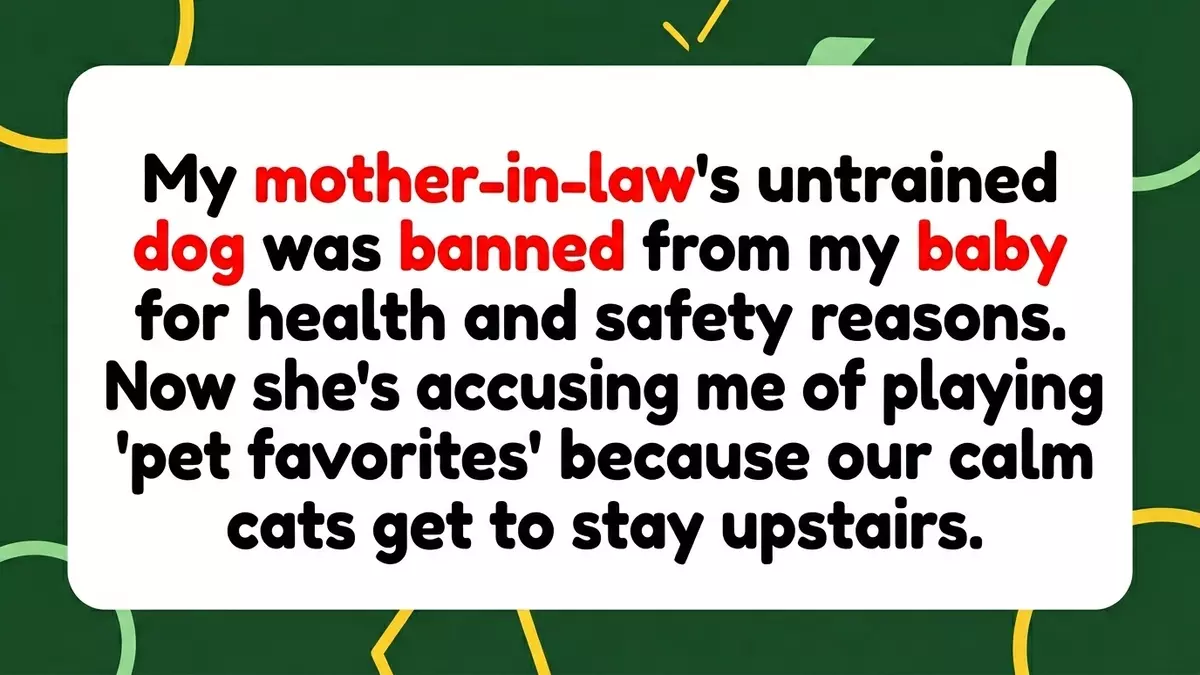
To successfully de-escalate this type of family drama, it is useful to look at why the mother-in-law reacted with such intense defensiveness. Psychologists recognize that many dedicated pet owners view their animals as direct extensions of themselves or as surrogate children.
When the mother restricted the dog’s access to the baby, the mother-in-law did not see a safety critique aimed at a canine; she felt a profound sense of personal rejection. The boundary was internalized as a declaration that her "baby" wasn't clean or good enough, which she then translated into a judgment of her own character and past parenting abilities. This intense emotional projection completely blinds the relative to the physical realities of the situation, replacing objective logic with deep-seated resentment.
How to Establish In-Law Boundaries Safely
Protecting a child from an untrained pet is a parent’s fundamental obligation, but communicating that reality requires strategy to prevent permanent relationship damage. Experts suggest shifting the family conversation completely away from emotional comparisons and focusing entirely on structural solutions.
-
Create Physical, Neutral Zones: Instead of debating the dog's worth, establish explicit, permanent pet-free zones in the home during family visits. Utilizing sturdy baby gates removes the need for constant verbal reminders and emotional negotiation.
-
Frame Rules Around Baby Needs, Not Dog Flaws: De-escalate defensiveness by changing your language. Instead of saying, "Your dog is too wild and dirty," frame the rule around the infant's schedule. Use phrases like, "The pediatrician wants us to keep the floor completely sterile right now," or "We are keeping the house completely quiet to protect his nap windows."
-
Keep Explanations Brief and Absolute: Avoid over-explaining your choices, as this invites debate. State your household boundaries clearly, calmly, and consistently.
Ultimately, a parent’s duty to safeguard their child’s physical well-being must always take priority over managing an adult's temporary emotional sensitivities.
FAQs
Is it safe to have an untrained dog around a six-month-old baby?
No, it is highly risky. Infants are fragile, unpredictable, and easily injured by accidental impacts. An untrained dog lacks basic impulse control, meaning it may jump, scratch, or snap when startled by a baby's sudden movements or high-pitched cries.